
USDA B&I RV Park Acquisition and Expansion Case Study: Willey Brook Campground, Wolfeboro, New Hampshire, Feasible at $1.96 Million, Expansion Not Feasible Above $36,300 per Site
A model feasibility study and valuation of a listed 60-site seasonal campground financed with a USDA Business and Industry guaranteed loan, with a proposed expansion to 100 sites. The case is built on the valuation problem that B&I campground files share: the as-is value of the operating park against the prospective value with new sites, capitalisation rates set by site mix rather than by survey average, and the deductions 7 CFR Part 5001 makes before a lender counts collateral, for going-concern value, for the owner's residence and for discounting.
By Robert Mitchell, MAI, SRA, AI-GRS, UnionMetric Feasibility | 6 October 2026
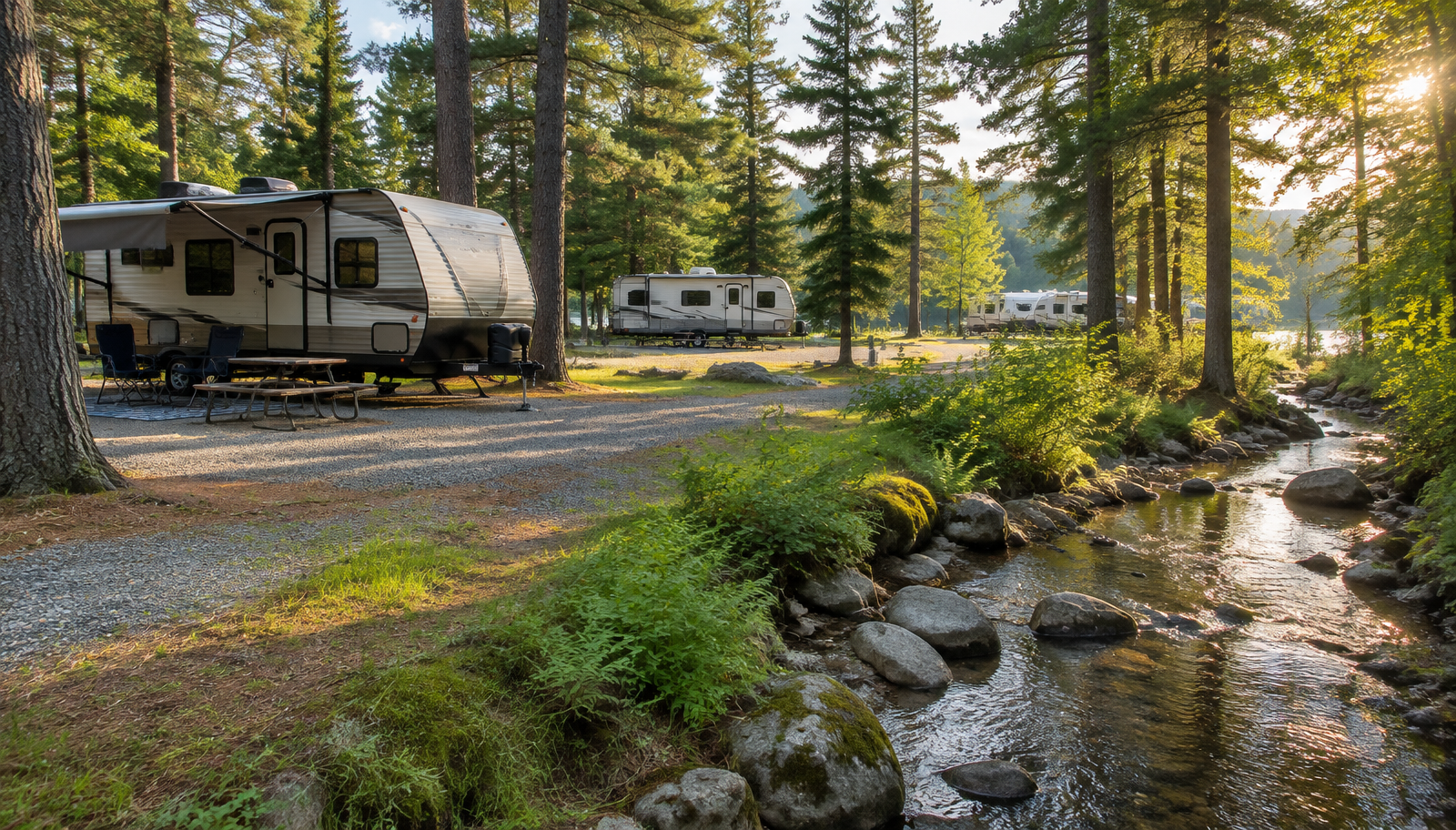
Study at a Glance
| Item | Finding |
|---|---|
| Subject | Willey Brook Campground (also marketed as Wiley Brook), 883 Center Street (NH Route 28), Wolfeboro, New Hampshire 03894, Carroll County |
| Parcel | Tax Map/Lot 102-008 (main campground lot), with a companion lot in the tested package |
| Improvements | 60 serviced campsites plus tent sites; bathhouse, camp store, sheds and storage buildings; 2,025 SF owner's residence built 2015; about 480 feet of frontage on Willey Brook |
| Land | 74.07 acres in the tested package (packages range from 74.07 to 84.01 acres); about 8 acres developed |
| Season | Mid-May to mid-October, about 153 nights |
| Listed price | $3,200,000 for the tested package; $2,700,000 to $3,500,000 across packages |
| Financing | USDA B&I guaranteed loan on FY2026 terms: 85% guarantee, 3.0% upfront fee, 0.55% annual fee |
| Market value as is | $1,960,000 |
| Of which, operating campground (going concern) | $1,220,000 ($20,333 per site) |
| Prospective value upon completion of 40 new sites (May 2028) | $3,530,000 |
| Prospective value upon stabilisation (May 2030) | $3,760,000 |
| Expansion test | Stabilised value of the 40 new sites is 80% of their $1,811,000 cost |
| Supportable B&I loan | $990,000, sized at 1.25x coverage on the operating park |
| Determination | Acquisition feasible at $1.96 million; expansion not feasible above $36,300 per site all in |
Determination
The acquisition of Willey Brook Campground is feasible at $1,960,000, the concluded market value as is of the tested 74.07-acre package, which comprises the operating park, the owner's residence and the surplus land. At that price the park supports a B&I guaranteed loan of $990,000, sized by coverage: stabilised EBITDA of $116,034 at 2026 rates covers debt service of $92,420, including the annual fee on the guaranteed portion, 1.26 times. The residence, valued at $450,000, cannot be financed with loan proceeds under 7 CFR 5001.105(b)(8) and is funded by the buyer, who contributes $1,096,245, or 52.5 per cent of a $2,086,245 project. Discounted collateral of $1,387,500 covers the loan 1.40 times.
The acquisition is not feasible at the $3,200,000 asking price for the tested package. That price capitalises the park's stabilised NOI at 3.5 per cent. A loan of 75 per cent of eligible cost at that price would cover its debt service 0.57 times.
The proposed 40-site expansion is not financially feasible at modelled 2026 cost. A budget of $1,811,000, or $45,275 per site all in, produces stabilised incremental NOI of $127,166, a yield on cost of 7.0 per cent against an 8.75 per cent capitalisation rate for new seasonal income. On stabilisation the new sites would be worth $1,453,300, or 80 per cent of what they cost to build. Value equals cost at an all-in cost of $36,300 per site, or at a seasonal rate of about $5,075 against the $4,250 modelled. The zoning variance needed to build them was continued in April 2026 and its outcome was not found. The B&I loan is therefore sized on the operating park alone, and any expansion tranche is conditioned on the variance, state subsurface disposal approval, a fixed-price contract at or below the break-even cost, and signed seasonal commitments for at least half of the new sites.
The two conclusions meet in an uncomfortable place for the seller. Most of what the buyer pays for is not income. Of the $1.96 million value, $1.22 million is the operating campground; the residence and the surplus land make up the rest, and the B&I rules finance neither on the strength of the park's cash flow. The income sets the loan, and the loan is half the price.
Scope, Basis and Data Verification
This is a model study. UnionMetric was not engaged on this property, did not inspect it, and has no relationship with the seller, the listing broker or any prospective buyer. The subject is a real campground that was publicly listed for sale as of the effective date, 6 October 2026. It was chosen because its public record contains the elements this case is meant to teach: an operating park with no disclosed income, an owner's residence on the same land, a large surplus land holding, a proposed expansion that needs a variance, and a rural location eligible for B&I. The value indications illustrate method on public data and labelled assumptions. They are not an appraisal, they are not an opinion of market value for any intended user, and they must not be relied on in any transaction involving the property.
The study follows the sequence a lender-grade engagement follows on a B&I acquisition-and-expansion file: eligibility, entitlement, market and competitive analysis, an operating model built from posted rates because no income was disclosed, highest and best use, the approaches to value with capitalisation rates set by income stream, the separation of business value, personal property, the residence and the surplus land, an expansion feasibility test, prospective values upon completion and stabilisation, and loan sizing against value, coverage and discounted collateral. The USDA feasibility study page sets out how the study fits the B&I application.
| Status | Items |
|---|---|
| Primary-verified | FY2026 B&I guarantee percentages and fees (91 FR 11272, 9 March 2026); 7 CFR 5001.105(b)(8), 5001.105(d), 5001.202(b)(4), 5001.203 and 5001.205 (eCFR, current to early October 2026); the USDA B&I programme page; Wolfeboro's 2025 tax rate and valuation (NH Department of Revenue Administration); Wolfeboro's 2020 Census population; MLS listing facts (updated 2 September 2026); posted 2026 rates at Wolfeboro Campground, Gunstock Campground, Ellacoya State Park and White Lake State Park; Willey Brook's posted 2026 rates; RVIA August 2026 shipments; KOA 2026 report headline figures; the Wassamki Spring sale (Portland Press Herald, 18 September 2026); the parcel, zoning district, variance case and 2025 revaluation from town minutes and ordinances |
| Secondary | The 2024 assessment and taxes (MLS, seller-reported); Westward Shores and Lake Ivanhoe rates (aggregators); construction cost per site (2026 industry sources); capitalisation rate surveys (BVWire, March 2026); transient and long-term rate and expense ranges (2026 industry commentary); RVIA's summer 2026 forecast (trade press); the Winding River acquisition (press release, November 2024) |
| Not obtained | The park's revenue and NOI; town-confirmed 2025 and 2026 assessments and bills; competitor assessments; state park and tourism visitation; a dated USDA eligibility map query; the variance outcome; the FY2027 OneRD fee notice |
| Modelled | Site mix, seasonal and blended transient rates, occupancy by period, expenses, capitalisation and discount rates, residence and surplus land values, the expansion budget, lease-up, the interest rate and collateral discount factors |
The Valuation Problem This Case Is Built On
A B&I acquisition-and-expansion file asks for two values and gets four problems. The regulation requires an as-is value and a prospective value as of construction completion. Between them sit the questions that decide the loan.
The first is the site mix. An RV park is not one income stream. Seasonal contracts behave like short leases with renewal waitlists; transient nights behave like hospitality, with weather, weekend and fuel-price volatility; the camp store is a small retail business. Capitalising all three at a single survey average misprices the park in whichever direction its mix leans.
The second is what the lender can count. Part 5001 requires any going-concern or business value to be deducted from the reconciled market value before collateral is discounted, and it requires the pro rata value of a direct owner's living quarters to be deducted from the use of loan proceeds. On this property the residence and the surplus land are a large share of the price, and neither is supported by campground income.
The third is entitlement. The expansion requires a variance for a non-conforming use. Until it is granted, the 40 new sites are a hypothetical condition, not part of the as-is value.
The fourth is whether the expansion creates value at all. A prospective value upon stabilisation that exceeds the as-is value is not proof of feasibility. The test is whether the value the new sites add exceeds what they cost to build.
Method. The as-is and prospective values answer different questions and carry different dates. The as-is value is what the lender has on the day the loan closes. The prospective values are forecasts, effective on the completion and stabilisation dates, and reported as prospective opinions with their assumptions stated. A lender that sizes a loan on a prospective value is lending against a forecast, and the study must say so.
Project Business Plan
The Project is the acquisition and continued operation of Willey Brook Campground, a seasonal family campground at 883 Center Street (NH Route 28) in Wolfeboro, New Hampshire, with a proposed expansion from 60 to 100 serviced sites. The existing park has 60 serviced campsites with water, on-site septic, electric service and Wi-Fi in a mix of 30-amp water and electric, 30-amp full hook-up and 50-amp full hook-up configurations, plus tent sites, a bathhouse, a camp store selling firewood, ice and propane, sheds and storage buildings, a playground and horseshoe pits, and about 480 feet of frontage on Willey Brook, all within about 8 developed acres of the 74.07-acre package. A 2,025 SF two-bedroom, two-bath owner's residence built in 2015 stands on the property. The park opens from mid-May to mid-October, about 153 nights, and is run by a resident owner-operator with seasonal help; the model prices an on-site manager and seasonal labour at market cost. The buyer acquires the fee simple real estate and the operating business through a single operating entity. The expansion would add 40 full hook-up 50-amp seasonal sites at the rear of the property, about 1,000 feet from the nearest neighbour, with a maintenance building and, as proposed to the town, a pool. The park is positioned as a quiet, wooded family seasonal park a short drive from Lake Winnipesaukee and Lake Wentworth, priced at or slightly above its nearest independent peer and below the public lakefront campgrounds and the institutional lakefront resort.
Marketing & Sales Strategy
The strategy is seasonal-first. Existing seasonal campers are offered renewal at the end of each season against a deposit, which turns the park's most stable income into contracted income before the next season opens. New seasonal sites are sold from the park's own transient guest list, because a family that returns for several weekends a summer is the most likely seasonal buyer, and through regional campground association listings and seasonal-site boards. The closed seasonal waitlist at the county-owned resort campground in Gilford shows unmet seasonal demand in the region, and the park's sales effort is aimed at that overflow. Transient nights are sold through the park's own booking page and camping reservation platforms, with three-night minimums on holiday weekends. The built-in acquisition channel is the conversion of repeat transient guests into seasonal contracts.
Amenities
- 60 serviced campsites with water, on-site septic, electric service and Wi-Fi, plus tent sites
- Site types: 30-amp water and electric; 30-amp full hook-up; 50-amp full hook-up
- Bathhouse
- Camp store with firewood, ice and propane
- Playground and horseshoe pits
- Sheds and storage buildings
- About 480 feet of frontage on Willey Brook
- Sub-metered electric service to sites
- 2,025 SF two-bedroom, two-bath owner's residence built in 2015
- Proposed: 40 additional full hook-up 50-amp seasonal sites, a maintenance building and a pool
Subject Property: Site, Improvements, Utilities and Tax
The main campground lot is Tax Map/Lot 102-008 on NH Route 28, about two miles from downtown Wolfeboro. The developed park occupies about 8 acres; the balance of the package is wooded land behind it. The public record conflicts on most of the basic facts.
| Data point | Values found | Treatment |
|---|---|---|
| Asking price and package | $3,500,000 for 84.01 acres with two additional lots; $3,200,000 for 74.07 acres without them; $3,000,000 for 84.01 acres; $2,700,000 for 74.84 acres | $3,200,000 package tested; reconciled with the listing agent at engagement |
| Acreage | 84.01, 74.84, 74.07 and 63.07 acres; about 8 of "68 acres" developed per a prospective buyer's statement to the Planning Board | 74.07 acres tested; about 8 acres developed |
| Site count | 60 campsites (listings); 62 (one MLS version); "Total Units: 63" (one MLS record); 27 sites with 23 full hook-ups (older directory) | 60 used; the older count is stale but is checked at diligence |
| Site mix by type | Not published | Modelled |
| Seasonal and transient split | "A mix of seasonal and short term sites"; no split stated | Modelled at 30 and 30 |
| Revenue and NOI | Not disclosed in any listing | Built from posted rates |
| Expansion approvals | A marketing article claims "preliminary municipal approval for an additional 20+ sites"; the town record shows a variance request continued in April 2026 | Claim treated as unverified |
| Listing status | Active on PrimeMLS, updated 2 September 2026, while a named prospective buyer pursued the variance in spring 2026 | Contract status unknown |
Method. When no income is disclosed, the study builds income from posted rates, a stated site mix and a period-by-period occupancy model, and it labels every one of those inputs. The weakness is not that the income is modelled. It is when a modelled figure is presented as the park's own, and a lender closes on it without the reservation records that would replace it.
Utilities are on site. The park runs on a septic system with leach field (one listing shows a 1,000-gallon tank) and an on-site water supply, with electric service sub-metered to the sites. There is no municipal sewer. Any expansion therefore needs a new subsurface disposal system designed for the added sites and approved by the state, which is the single largest cost item in the expansion budget and the subject of the watershed objections recorded at the zoning hearing.
The MLS reports a 2024 assessment of $656,843 and 2024 taxes of $10,500. The two figures appear to cover different lot groupings, since together they imply a rate of about $16 per $1,000, nearly double Wolfeboro's rate. The town's 2025 rate is $8.36 per $1,000 (municipal $3.21, county $0.71, state education $1.07, local education $3.37), set on a total valuation of $4.81 billion in November 2025. A town-wide revaluation took effect on 1 April 2025, and the Select Board was told that values had risen 80 per cent across the town in five years, so any 2024 assessment is stale. Had the $656,843 assessment risen in line, the 2025 tax would be about $9,900. The model carries $10,000 in total, of which $6,200 is charged to the campground and $3,800 to the residence.
Zoning and Entitlement
The property lies in Wolfeboro's Residential/Agricultural District. Campgrounds are neither a permitted use nor a special exception use in that district, so the park operates as a pre-existing non-conforming use, and expansions are governed by the ordinance's non-conforming use provisions. An expansion of more than 25 per cent was granted once before by special exception in 2021, so the current proposal requires a variance.
On 6 April 2026 the Zoning Board of Adjustment heard Case 2026-V-003, a variance for an expansion of the non-conforming campground use by more than 25 per cent, from 60 to 100 sites, with the 40 new sites at the rear of the property about 1,000 feet from the nearest neighbour, together with a maintenance building and a pool. A watershed association raised septic and wetlands concerns because the brook feeds Lake Wentworth. The board voted 4 to 1 to continue the case to 20 April 2026 and asked for seasonal-use dates, lot sizes, a wetlands map, soil types, a fire and water supply plan, and a road design. The outcome was not found. New Hampshire boards decide variances against the five criteria in RSA 674:33, and the information the board requested goes to the criteria on public interest, surrounding property values and hardship.
The study therefore treats entitlement as a scenario, not a fact.
| Scenario | Sites | Consequence |
|---|---|---|
| Variance granted as requested | 100 | Expansion tested at full scale; feasibility depends on cost and seasonal rate |
| Variance granted with conditions (for example, fewer sites after septic and wetlands limits) | About 80 | The septic system, road and fire supply are largely fixed costs; spreading them over fewer sites raises cost per site and widens the deficit |
| Variance denied | 60 | Park continues as is; the rear land remains surplus land |
Method. The as-is value reflects the entitlements in place on the effective date, and a pending variance is not one of them. The expansion enters only the prospective values, under a stated hypothetical condition that the variance and state approvals have been granted. Non-conforming rights also depend on continued operation: the lender's counsel confirms the ordinance's provisions on discontinuance and on restoration after damage, because those provisions, not the appraisal, decide whether the park can be rebuilt if the bathhouse burns down.
USDA Rural Area and Use Eligibility
For B&I, 7 CFR 5001.3 defines a rural area as any area other than a city or town with a population over 50,000 and the urbanised area contiguous and adjacent to it. Wolfeboro had 6,416 residents in the 2020 Census and an estimated 6,637 in July 2025. The nearest cities, Rochester (32,492) and Concord (43,976), are both below the threshold, and Wolfeboro lies inside no qualifying urbanised area. On the regulatory definition the site is rural. In an engagement the determination is documented with a dated screenshot of the USDA Rural Development eligibility map query for the street address, saved to the file.
The use is eligible. Section 5001.105(b)(8) lists resort trailer parks and campgrounds operated as a public or private commercial enterprise among eligible projects. The same paragraph requires that the pro rata value of a direct owner's living quarters, based on square footage, be deducted from the use of loan proceeds. Because the residence here is a separate dwelling rather than living space within a commercial building, the proration resolves to the residence's whole contributory value, which the buyer funds outside the loan.
Market Area and Demand
Wolfeboro sits on the southeast shore of Lake Winnipesaukee in the Lakes Region, a summer market built on second homes, lake recreation and family camping. A New Hampshire campground opens for about five months, so there are no year-round annual sites; the choice is between seasonal contracts and transient nights.
Demand at the household level is stable. KOA's 2026 report counts more than 52 million North American households camping in 2025, above pre-pandemic levels, with $66 billion of local spending; 31 per cent of campers planned more nights in 2026. RV camping accounted for 47 per cent of trips, the lowest share the report has recorded.
Demand at the equipment level is softening. RVIA reported August 2026 wholesale shipments of 23,599 units, down 16.4 per cent from August 2025, and year-to-date shipments of 207,191, down 14.2 per cent. Towables fell 16.9 per cent and motorhomes 11.7 per cent, while park model RVs rose 21.8 per cent year to date. The summer 2026 forecast puts full-year shipments at a median of 314,000, an 8.2 per cent decline, after an initial projection of a 3.6 per cent increase. For a seasonal-heavy park whose customers already own their rigs, falling new-unit sales are a medium-term headwind, not an immediate occupancy threat.
The strongest local evidence is seasonal. Gunstock Campground's 52 seasonal sites were fully booked for summer 2026 with the waitlist closed, and a southern New Hampshire lakefront park reported its seasonal sites full for 2025 at $4,500 a season. Seasonal demand in the Lakes Region runs deeper than transient demand, and the expansion case rests on it.
Competitive Supply: Competitor Census
Distances are approximate road distances from the subject. New Hampshire assesses property by town rather than by county, so competitor taxes and acreage come from the assessing offices in Wolfeboro, Ossipee, Wakefield, Gilford and Tamworth at engagement.
Competitor Number 1
Wolfeboro Campground
This 50-site wooded campground offers RV sites with water, sewer and electric service for trailers up to 32 feet, and did not rent tent sites in 2026. It is located at 61 Haines Hill Road, Wolfeboro, NH, about one mile from the subject. Its posted RV rate is $45 per night, effective 1 January 2026, with a two-night weekend minimum and seasonal sites by inquiry. It operates from about 22 May to 11 October 2026.
Competitor Number 2
Sun Retreats Westward Shores
This institutionally owned lakefront resort offers about 25 premium full hook-up RV sites with 30 and 50-amp service for rigs up to 60 feet, plus about 34 cabins, cottages, lodge units and park models (one directory count). It is located at 110 Nichols Road, Ossipee, NH, about 15 miles from the subject, on Ossipee Lake with a beach, marina, pool and hot tub. Booking aggregators show 2026 rates from about $70 to $145 per night.
Competitor Number 3
Lake Ivanhoe Inn and Campsites
This lakeside campground of 47 to 65 sites (sources differ) offers full and partial hook-ups with 20 and 30-amp service for rigs up to 46 feet. It is located at 631 Acton Ridge Road, East Wakefield, NH, about 15 miles from the subject. A booking aggregator lists deluxe full hook-up sites at $48 per day and $300 per week, and tent sites at $39 to $42.
Competitor Number 4
Gunstock Campground
This county-owned resort campground offers about 206 to 260 sites: 89 basic, 35 water and electric (20 and 30-amp), 54 water and electric (50-amp) and 28 full hook-up 50-amp sites, including 52 seasonal sites. It is located at 719 Cherry Valley Road, Gilford, NH, about 25 miles from the subject. Full hook-up sites are $60 midweek and $70 at weekends, 50-amp water and electric sites $55 and $65, and basic sites $40 and $45. Its seasonal sites for summer 2026 were fully booked with the waitlist closed.
Competitor Number 5
Ellacoya State Park RV Campground
This 37-site state park campground offers full hook-ups only, with no tents and no pets. It is located at 280 Scenic Drive, Gilford, NH, about 25 miles from the subject, behind a 600-foot sandy beach on Lake Winnipesaukee. Its 2026 rate is $60 per night per rig.
Competitor Number 6
White Lake State Park
This 192-site state park campground has no hook-ups. It is located at 94 State Park Road, Tamworth, NH, about 25 miles from the subject. Its 2026 peak-season rates, from 21 May to 11 October, run from $40 for standard sites to $105 for large sites, plus a $7 online reservation fee.
Bearcamp River, Whit's End and Calumet Family campgrounds in West Ossipee, Viewland Campground in Alton (itself listed for sale at $1,100,000) and the seasonal-only Harbor Hill Camping Area in Meredith complete the census in an engagement.
| Site type | Subject, 2026 | Market | Position |
|---|---|---|---|
| Full hook-up, 50-amp | $55, plus $2 a day for 50-amp and $3 a day for air conditioning | $45 (Wolfeboro Campground, full hook-up) to $60 and $70 (Ellacoya; Gunstock) | Mid-market |
| Full hook-up, 30-amp | $50 | $45 to $48 (Wolfeboro Campground; Lake Ivanhoe) | At or above independents |
| Water and electric, 30-amp | $48 | $55 to $65 for 50-amp water and electric at Gunstock | Below the public resort |
| Tent or basic | $42 | $39 to $45 (Lake Ivanhoe; Gunstock); $40 at White Lake | At market |
| Seasonal | Not published | $4,500 at a southern New Hampshire lakefront park (2025, including water, sewer and cable) | Modelled at $3,600 |
The subject's transient rates sit at or slightly above its nearest independent peer and $5 to $15 below the public full hook-up benchmarks. There is some room to raise rates as facilities improve, but the expansion case should rest on seasonal contracts and modest rate growth, not on resort pricing. Only the institutional lakefront resort achieves $70 to $145, and it sells a lake, a beach and a marina the subject does not have.
Occupancy and Revenue Model
Transient occupancy is built period by period, because a season-wide average hides the weekend and holiday concentration that drives a New Hampshire park.
| Period | Nights | Modelled occupancy | Occupied nights per site |
|---|---|---|---|
| July and August | 62 | 70% | 43.40 |
| June and September | 60 | 40% | 24.00 |
| Late May and early October | 31 | 25% | 7.75 |
| Season | 153 | 49.1% | 75.15 |
Generic national inputs, such as 60 per cent occupancy for transient parks and 90 per cent for long-term parks with a 45 per cent expense ratio, are calibrated to year-round operations and are not used for a 153-night season. The model assumes 30 seasonal and 30 transient sites, a seasonal rate of $3,600 (below the $4,500 lakefront benchmark, for a brookside wooded park), and a blended transient rate of $52 across the posted site types and surcharges.
| Revenue line | Basis | Amount | Share |
|---|---|---|---|
| Seasonal site revenue | 30 sites at $3,600 | $108,000 | 44.0% |
| Transient site revenue | 30 sites x 75.15 occupied nights x $52 | $117,234 | 47.8% |
| Ancillary income, net of cost of goods | Store, firewood, propane, visitor and extra-person fees | $20,000 | 8.2% |
| Total revenue | $245,234 | 100.0% |
Ancillary income at 8 per cent of revenue is net of cost of goods and sits below the 10 to 25 per cent gross ancillary share cited across the industry, which includes larger parks with full stores and rentals.
Stabilised Operating Statement, As Is
| Line | Amount | % of revenue | Per site |
|---|---|---|---|
| Total revenue | $245,234 | 100.0% | $4,087 |
| Management (imputed, on site, excluding housing) | $36,000 | 14.7% | $600 |
| Seasonal labour | $28,000 | 11.4% | $467 |
| Utilities (net of metered seasonal electric) | $16,000 | 6.5% | $267 |
| Water system, septic pumping and solid waste | $9,000 | 3.7% | $150 |
| Repairs and maintenance | $11,000 | 4.5% | $183 |
| Insurance | $8,500 | 3.5% | $142 |
| Real estate taxes (campground share) | $6,200 | 2.5% | $103 |
| Marketing, website, reservation software and card fees | $8,500 | 3.5% | $142 |
| Administration, professional fees and licences | $6,000 | 2.4% | $100 |
| Reserve for replacement ($75 per site) | $4,500 | 1.8% | $75 |
| Total expenses | $133,700 | 54.5% | $2,228 |
| Net operating income | $111,534 | 45.5% | $1,859 |
| EBITDA (NOI before the reserve) | $116,034 | 47.3% | $1,934 |
The expense ratio of 54.5 per cent sits inside the 50 to 65 per cent range reported for transient-heavy parks and above the 45 per cent generic assumption, which is right for a small park carrying a full-time manager over a short season. Management is imputed even though the seller runs the park personally, because a lender underwrites arm's-length costs. The reserve follows the $75 per pad used in a 2026 national valuation survey.
Method. Owner-operated parks often report expenses that leave out the owner's labour and the house the owner lives in. The study prices the management cost at market without a housing benefit and values the residence separately. Doing both, or neither, is consistent. Imputing a full wage and also crediting the residence to the park's income would count the house twice.
Highest and Best Use
As though vacant, the land lies in a Residential/Agricultural District in which campgrounds are not permitted, so a new campground is not legally permissible. Low-density residential and agricultural uses are permissible, subject to frontage, wetlands near the brook and on-site septic capacity, and rural residential land is the maximally productive use of the site as though vacant.
As improved, the campground is a legal non-conforming use whose operating value, $1.22 million on the developed 8 acres, far exceeds what those acres would fetch as residential land. Continued operation as a seasonal campground is the highest and best use as improved. The expansion is not legally permissible on the effective date because the variance has not been granted, so it does not form part of the highest and best use as is. It is analysed below as a proposed change, under its own feasibility test.
Income Capitalisation by Site Mix
The park's NOI is divided by income stream, and each stream is capitalised at a rate that reflects its own risk.
| Stream | Revenue | Margin | NOI | Rate | Value |
|---|---|---|---|---|---|
| Seasonal contracts | $108,000 | 62.0% | $66,960 | 8.25% | $811,636 |
| Transient nights | $117,234 | 26.9% | $31,574 | 10.00% | $315,740 |
| Ancillary business | $20,000 | 65.0% | $13,000 | 14.00% | $92,857 |
| Total | $245,234 | 45.5% | $111,534 | 9.14% blended | $1,220,233 |
Seasonal income carries a 62 per cent margin because seasonal campers maintain their own sites, pay their own metered electric and generate no turnover costs. Transient sites carry the cleaning, booking, card and front-desk costs, and with them most of the park's overhead, so their margin is 26.9 per cent. The capitalisation rates follow the published evidence: Class A and B parks trading at going-in rates around 8.0 per cent and Class C parks closer to 9.0 per cent (BVWire, March 2026), long-term and workforce parks at about 7.5 to 9.0 per cent, and transient parks priced more like hospitality. Willey Brook is a Class C park in a Class A location; its seasonal income earns a rate near the Class A and B level only because seasonal demand in the region is documented, and the transient income carries a hospitality-level rate.
The blended result, 9.14 per cent, is close to the 9.0 per cent Class C survey figure, which on its own would have indicated $1,239,300. The point of the component build is not that it produces a different number on this mix. It is that it produces the right number when the mix changes.
| Seasonal / transient sites | NOI | Value by component | Implied blended rate |
|---|---|---|---|
| 20 / 40 | $111,112 | $1,168,700 | 9.51% |
| 30 / 30 (modelled) | $111,534 | $1,220,200 | 9.14% |
| 40 / 20 | $111,956 | $1,271,800 | 8.80% |
The same NOI is worth $103,100 more at a 40 / 20 mix than at a 20 / 40 mix, because the income is safer. A single survey rate would have valued all three mixes identically.
Method. Credit seasonal income with a lower rate only where the renewal history is documented. A seasonal roster that turned over completely last year is transient income paid in advance. The reservation and renewal records requested at diligence decide which rate each site earns, and the rent roll should show, site by site, how many consecutive seasons each contract has renewed.
The operating campground's value by the income approach is $1,220,000, or $20,333 per site.
Sales Comparison
Closed-sale evidence for New England campgrounds is thin, and only one priced regional sale was verified. Wassamki Spring Campground in Scarborough and Gorham, Maine, sold in August 2026 for $6,000,000: 261 sites on 78 acres, about $22,989 per site. Adjusted for its location near the Portland metropolitan area (minus 5 per cent), its pond and sandy beach (minus 10 per cent) and its scale, which lowers cost per site and raises value per site for a buyer (plus 5 per cent), it indicates about $20,638 per site, or $1,238,300 for 60 sites. Winding River Campground in Exeter, New Hampshire (202 sites) was acquired in November 2024, but the price was not disclosed.
Active asking prices are excluded from the analysis. The subject's own packages ask $45,000 to $58,333 per site, Viewland Campground in Alton asks $1,100,000, an unnamed southern New Hampshire park asks $1,990,000, and a 64-site Montana park asks $109,375 per site at a stated 6.03 per cent rate. These are seller hopes, not market evidence.
The sales comparison indication of $1,238,300 supports the income approach. With one comparable it carries limited weight; registry of deeds searches in Carroll, Belknap, Strafford and Rockingham counties add three or four sales at engagement.
Cost Approach
The cost approach is not developed for the operating park. The age of its site improvements is unknown, accrued depreciation on 60 older sites and a bathhouse cannot be measured with any reliability, and buyers of operating campgrounds price them on income. USPAP permits an approach to be omitted when it is not necessary for credible results, provided the reason is stated, and that is the case here.
The cost approach is essential for the expansion, because the expansion's feasibility is a comparison of cost with the value it creates. It is developed in that section.
Residence and Surplus Land
The 2,025 SF residence built in 2015 has a contributory value of $450,000, about $222 per SF (modelled). That figure reflects Wolfeboro's residential values after the 2025 revaluation, discounted because the house sits within the campground parcel and cannot be sold separately without a subdivision approval.
About 65 acres lie outside the developed park and the residence. They are surplus land rather than excess land: they cannot be sold separately without subdivision approval and frontage, and they have no use independent of the park on the effective date. Their contributory value is $290,000, about $4,500 per acre (modelled), reflecting rural wooded backland with wetlands near the brook. The rear acres proposed for the 40 new sites are part of this surplus land until the variance is granted.
Method. Excess land can be sold off without harming the operating property and is valued at its own highest and best use. Surplus land cannot be separated and is valued only for what it contributes. Calling surplus land excess land inflates value, because it prices acres that cannot actually be sold. On a B&I file the distinction also decides what the lender can treat as marketable collateral.
Reconciliation: Market Value As Is
| Component | Value | Basis |
|---|---|---|
| Operating campground, going concern (60 sites) | $1,220,000 | Income capitalisation by site mix; sales comparison supporting |
| Owner's residence | $450,000 | Contributory value |
| Surplus land, about 65 acres | $290,000 | Contributory value |
| Market value as is | $1,960,000 |
The as-is value is 61 per cent of the $3,200,000 asking price for the tested package. Capitalised at the park's blended 9.14 per cent, that price would require NOI of about $292,500, more than two and a half times what 60 sites can earn in a 153-night season at current rates. Even after setting aside the residence and the surplus land at their contributory values, the campground alone would need about $224,800. The asking price is explained by land, the house and an expansion that is not yet entitled, and the B&I rules discount or exclude all three.
B&I Deductions: Going-Concern Value, Personal Property and the Owner's Residence
Section 5001.203 requires that any value attributed to the business or the going concern be deducted from the reconciled market value before collateral is discounted. In an RV park most of the income is real property income: a campsite is land with improvements, rented by the night or the season. The business component is the ancillary operation and the in-place reservation base, valued here at $95,000, the capitalised value of the ancillary business income. Personal property (store fixtures, maintenance equipment, a utility vehicle, picnic tables and fire rings) is valued separately at $45,000.
| Step | Amount |
|---|---|
| Market value as is | $1,960,000 |
| Less business value (ancillary operation and reservation base) | ($95,000) |
| Less personal property, valued separately | ($45,000) |
| Real property value as is | $1,820,000 |
| Of which: campground real property $1,080,000; residence $450,000; surplus land $290,000 | |
| Discounted real property at 75% | $1,365,000 |
| Discounted personal property at 50% | $22,500 |
| Discounted collateral value | $1,387,500 |
Part 5001 sets no fixed discount factors. Section 5001.202(b)(4) requires the lender to discount collateral consistent with sound loan-to-discounted-value practice, considering type, quality, location, marketability and alternative uses, and to justify the discounts it uses; intangible assets may serve as collateral but not as primary collateral. The 75 per cent factor for real estate and 50 per cent for used equipment are common lender practice and are modelled here. A lender might reasonably discount the surplus land more heavily than the campground, given its limited marketability.
The residence is a use-of-proceeds deduction, not a collateral deduction. Its value cannot be financed with loan proceeds, but it can still secure the loan, and here it does.
Method. Three different subtractions are easy to merge and should not be. The going-concern deduction removes value that is not real property. The living-quarters deduction removes cost the loan may not pay for. The collateral discount reduces the value the lender counts. Each comes from a different provision, applies to a different number, and belongs on its own line of the credit memorandum.
The Expansion: Budget, Lease-Up and the Feasibility Test
The expansion budget is built for a site on septic, near wetlands and under watershed scrutiny.
| Item | Cost | Per site |
|---|---|---|
| Site development, 40 full hook-up 50-amp sites (pads, water, electric, sewer laterals) | $1,040,000 | $26,000 |
| Subsurface disposal system sized for 40 sites | $240,000 | $6,000 |
| Interior road, fire cistern and water supply | $160,000 | $4,000 |
| Maintenance building | $120,000 | $3,000 |
| Engineering, wetlands delineation, state permits and land-use counsel | $95,000 | $2,375 |
| Contingency (10% of hard cost) | $156,000 | $3,900 |
| Total expansion cost | $1,811,000 | $45,275 |
The hard cost of the sites, septic system and road, $36,000 per site, sits at the low end of the $35,000 to $55,000 planning range for this site and below the $40,000 to $70,000 per pad cited for professionally engineered sites in 2026. Full hook-up utilities alone run from about $3,200 to more than $29,000 per site, with sewer the largest variable at $2,000 to $12,000 where a new septic system or drainfield is needed. The budget is not inflated to make the test fail.
The new sites are sold as seasonal contracts at $4,250 in 2027 terms, between the park's modelled $3,600 and the $4,500 lakefront benchmark, rising 3 per cent a year. Unleased new sites take overflow transient guests at 20 per cent of season nights.
| Season | New sites leased | Share | Seasonal rate | Seasonal revenue | Overflow transient | Ancillary | Incremental revenue | Incremental expense | Incremental NOI |
|---|---|---|---|---|---|---|---|---|---|
| 2028 | 20 | 50% | $4,378 | $87,550 | $34,670 | $3,090 | $125,310 | $44,702 | $80,608 |
| 2029 | 32 | 80% | $4,509 | $144,282 | $14,284 | $5,092 | $163,659 | $46,043 | $117,616 |
| 2030 | 38 | 95% | $4,644 | $176,475 | $3,678 | $6,229 | $186,382 | $47,424 | $138,958 |
Incremental expense is $935 per new site (water, septic pumping and waste $250; repairs $150; insurance $80; administration and card fees $170; reserve $75; real estate tax on the added assessment $210) plus $6,000 of added seasonal labour, both rising 3 per cent a year.
The feasibility test compares stabilised value with cost on the same price basis, 2027 terms.
| Item | Amount |
|---|---|
| Seasonal revenue, 38 of 40 sites at $4,250 | $161,500 |
| Overflow transient on 2 unleased sites | $3,366 |
| Ancillary spend by new seasonal campers ($150 per site) | $5,700 |
| Incremental revenue, stabilised | $170,566 |
| Incremental expense (40 sites at $935, plus $6,000 labour) | ($43,400) |
| Incremental NOI, stabilised | $127,166 |
| Value at 8.75% | $1,453,300 |
| Expansion cost | $1,811,000 |
| Value as a share of cost | 80% |
| Yield on cost | 7.0% |
| All-in cost per site at which value equals cost | $36,300 |
| Seasonal rate at which value equals cost | $5,075 |
| With a 10% development margin: all-in cost per site, or seasonal rate | $33,000, or $5,490 |
New seasonal income is capitalised at 8.75 per cent, 50 basis points above the park's established seasonal income, because new sites have no renewal history on the valuation date.
Method. The expansion test is the cost approach turned around. Instead of asking what the improvements are worth after depreciation, it asks whether new improvements will be worth what they cost. A prospective value upon stabilisation that exceeds the as-is value proves nothing on its own, because the lender also paid for the construction. The test that matters is whether the value added exceeds the cost added, with a margin for the risk of building it.
Prospective Values Upon Completion and Upon Stabilisation
Part 5001 requires, for construction projects, both the as-is market value and the prospective market value as of the date of construction completion. It does not require a value upon stabilisation, but a park that fills new seasonal sites over three seasons should have one, and lenders financing construction are expected under the interagency appraisal guidelines to consider both prospective values where they apply. Both values below rest on the hypothetical condition that the variance and the state subsurface and wetlands approvals have been granted and the 40 sites are built to the budget above, with construction between the 2027 and 2028 seasons.
| Component | Upon completion, May 2028 | Upon stabilisation, May 2030 |
|---|---|---|
| Operating park, 100 sites | $2,777,200 | $2,961,500 |
| Owner's residence, trended at 3% a year | $477,400 | $506,500 |
| Surplus land, about 57 acres remaining, trended at 3% a year | $272,100 | $288,700 |
| Prospective market value | $3,530,000 | $3,760,000 |
The value upon stabilisation capitalises 2030 income by stream: the existing park's seasonal, transient and ancillary income at 8.25, 10.00 and 14.00 per cent ($1,373,400), and the 38 leased new sites' income at 8.75 per cent ($1,588,100). The value upon completion discounts the 2028 and 2029 cash flows during lease-up and the stabilised park value at 11.0 per cent, the rate a buyer would require for taking on two seasons of lease-up risk.
The test that matters for the lender is the comparison on a common date. The as-is value of $1,960,000 plus the expansion cost of $1,811,000 is $3,771,000. The prospective value upon completion is $3,530,000, about $241,000 less, before any growth in the as-is value over the construction period is counted. Even the value upon stabilisation, two years later, does not recover what was spent to reach it.
The Pool: Contributory Value Test
The variance request included a pool. A pool and its deck, fencing and code-required equipment are modelled at $240,000. It would support a $4 a night premium on transient sites and $150 a season on renewals for existing and new seasonal sites, about $19,218 a year, against operating costs (water, chemicals, electricity, inspection, maintenance and insurance) of about $11,000. Net income of $8,218 capitalised at the park's blended 9.14 per cent adds about $89,900 of value, 37 per cent of the pool's cost. The pool is excluded from the financed scope. If the buyer wants it for the guest experience, it is funded from equity.
Method. An amenity is tested by its contributory value, not by guest preference. A pool can be what a family remembers and still be worth a third of what it cost. The test is the same for any amenity: the capitalised net income it adds, set against the money it takes to build.
B&I Programme Compliance Under 7 CFR Part 5001
| Requirement | Rule | This file |
|---|---|---|
| Eligible use | 5001.105(b)(8): campgrounds operated as a commercial enterprise are eligible; the pro rata value of a direct owner's living quarters is deducted from the use of loan proceeds | Eligible; $450,000 residence funded outside the loan |
| Rural area | 5001.3: outside cities over 50,000 and their contiguous urbanised areas | Wolfeboro, 6,416 (2020); rural on the definition; dated map query at engagement |
| Guarantee and fees | FY2026 notice, 91 FR 11272: 85% guarantee below $5 million; 3.0% guarantee fee; 0.55% annual retention fee on the outstanding balance times the guaranteed percentage; 0.50% for a loan note guarantee issued before construction completion | Upfront fee $25,245; first-year annual fee about $4,628 |
| Equity | 5001.105(d): for new businesses, at least 20% balance sheet equity or 25% of project cost; 25% where there is construction and the guarantee issues before completion; appraisal surplus does not count | 39.5% of eligible project cost |
| Appraisal | 5001.203: USPAP Standards 1 and 2, FIRREA, state Certified General appraiser, no more than one year old, reviewed under Standards 3 and 4 before closing; as-is and prospective values for construction; going-concern value deducted before discounting | As-is value $1,960,000; prospective values for the expansion; $95,000 business value deducted |
| Collateral | 5001.202(b)(4): all collateral secures the whole guaranteed loan; discounts justified by type, quality, location, marketability and alternative uses; intangibles not primary collateral | Real property at 75%, personal property at 50% (modelled); coverage 1.40x |
| Construction | 5001.205: a firm, fixed-price contract with an independent general contractor is favoured; borrower equity goes in before guaranteed loan funds | Condition of any expansion tranche |
| Term | Up to 40 years (programme page) | 25-year amortisation modelled; 30 years tested |
A newly formed entity buying the park is underwritten as a new business, which sets the equity test at 20 per cent of the balance sheet or 25 per cent of project cost. The FY2026 rates apply to loans obligated in fiscal year 2026, and the notice states that the rate in effect when a loan is made applies for its life. Fiscal year 2027 began on 1 October 2026, and no FY2027 notice had been published as of the effective date, so a loan obligated now takes its terms from the FY2027 notice when it appears. The study uses the FY2026 terms and is refreshed when the new notice is published. The USDA feasibility study consultant page explains who may prepare the study the Agency relies on.
Project Cost Estimate and Loan Assumptions
Location: 883 Center Street, Wolfeboro, NH 03894 | Sites: 60 | Land: 74.07 acres
| Item | Cost | Cost in % | Cost per Site |
|---|---|---|---|
| Acquisition | |||
| Campground Real Property (land and site improvements) | $1,080,000 | 51.8% | $18,000 |
| Surplus Land (about 65 acres) | $290,000 | 13.9% | $4,833 |
| Personal Property | $45,000 | 2.2% | $750 |
| Business Value (ancillary operation) | $95,000 | 4.6% | $1,583 |
| Owner's Residence (funded outside the loan) | $450,000 | 21.6% | $7,500 |
| Total Acquisition | $1,960,000 | 93.9% | $32,667 |
| Soft Cost | |||
| Third-Party Reports (feasibility study, appraisal and review, Phase I ESA) | $26,000 | 1.2% | $433 |
| Legal, Title and Closing | $35,000 | 1.7% | $583 |
| Total Soft Cost | $61,000 | 2.9% | $1,017 |
| Financial Cost | |||
| Working Capital Reserve (pre-season) | $40,000 | 1.9% | $667 |
| B&I Guarantee Fee (3.0% of the guaranteed portion) | $25,245 | 1.2% | $421 |
| Total Financial Cost | $65,245 | 3.1% | $1,087 |
| Total Subject Project Cost | $2,086,245 | 100.0% | $34,771 |
Source: Listing data, 7 CFR Part 5001, 91 FR 11272, UnionMetric
| Loan Assumptions | |
|---|---|
| LTC Ratio (eligible cost, excluding the residence) | 60.5% |
| LTC Ratio (total project cost) | 47.5% |
| Loan | $990,000 |
| Equity | $1,096,245 |
| Interest Rate | 7.50% (modelled) |
| Amortisation | 25 years |
| Annual Debt Service (principal and interest plus the 0.55% annual fee on the guaranteed portion) | $92,420 |
Eligible project cost, excluding the residence, is $1,636,245, of which the buyer funds $646,245, or 39.5 per cent. The loan carries an 85 per cent guarantee, $841,500. The expansion budget is tested above and is not part of the financed project.
Five-Year Pro Forma and Debt Service Coverage
The pro forma covers the acquisition as financed, without the expansion. Rates and expenses grow 3 per cent a year.
| Season | Seasonal | Transient | Ancillary | Total revenue | Operating expenses | NOI | EBITDA | Debt service | DSCR |
|---|---|---|---|---|---|---|---|---|---|
| 2027 | $111,240 | $120,751 | $20,600 | $252,591 | $137,711 | $114,880 | $119,515 | $92,420 | 1.29x |
| 2028 | $114,577 | $124,374 | $21,218 | $260,169 | $141,842 | $118,326 | $123,100 | $92,420 | 1.33x |
| 2029 | $118,015 | $128,105 | $21,855 | $267,974 | $146,098 | $121,876 | $126,793 | $92,420 | 1.37x |
| 2030 | $121,555 | $131,948 | $22,510 | $276,013 | $150,481 | $125,532 | $130,597 | $92,420 | 1.41x |
| 2031 | $125,202 | $135,906 | $23,185 | $284,293 | $154,995 | $129,298 | $134,515 | $92,420 | 1.46x |
Had the expansion been financed as proposed, with 25 per cent equity on a combined project of $3,529,500, the loan would have been $2,647,100 with debt service of $247,120. Coverage would have been 0.84 times in the first season of lease-up and 1.10 times at stabilisation. The combined park's stabilised cash flow supports only $2,338,900 of debt at 1.25 times.
Break-Even Analysis
| Measure | Break-even | Base | Margin |
|---|---|---|---|
| Transient season occupancy for 1.00x coverage | 39.2% | 49.1% | 9.9 points |
| Transient season occupancy for 1.25x coverage | 48.9% | 49.1% | 0.2 points |
| Seasonal sites that can go unsold before coverage falls below 1.00x | 6 of 30 | 30 of 30 | Seventh lost site breaches |
The loan is sized to coverage, so the margin to 1.25 times is thin by design. The protection lies in the 9.9 points of transient occupancy between the base case and the point at which the park stops covering its debt, and in the seasonal roster: losing six seasonal contracts is survivable, losing seven is not. That is why the seasonal renewal history is the most important document in the diligence request.
Sensitivity Analysis
| Acquisition scenario | NOI | Going-concern value | DSCR on $990,000 | Loan supported at 1.25x |
|---|---|---|---|---|
| Base | $111,534 | $1,220,200 | 1.26x | $994,400 |
| Transient occupancy minus 5 points | $99,600 | $1,100,900 | 1.13x | $892,100 |
| Transient occupancy plus 5 points | $123,468 | $1,339,600 | 1.38x | $1,096,600 |
| Seasonal rate minus $250 | $104,034 | $1,135,400 | 1.17x | $930,100 |
| Seasonal rate plus $250 | $119,034 | $1,305,100 | 1.34x | $1,058,600 |
| Capitalisation rates plus 50 basis points | $111,534 | $1,155,600 | 1.26x | $994,400 |
| Capitalisation rates minus 50 basis points | $111,534 | $1,292,700 | 1.26x | $994,400 |
| Interest rate plus 100 basis points | $111,534 | $1,220,200 | 1.16x | $916,300 |
| Amortisation over 30 years | $111,534 | $1,220,200 | 1.32x | $1,047,900 |
| Expansion scenario (2027 terms) | Incremental NOI | Value | Cost | Value / cost | Yield on cost |
|---|---|---|---|---|---|
| Base | $127,166 | $1,453,300 | $1,811,000 | 0.80 | 7.0% |
| Cost $5,000 per site lower | $127,166 | $1,453,300 | $1,611,000 | 0.90 | 7.9% |
| Cost $5,000 per site higher | $127,166 | $1,453,300 | $2,011,000 | 0.72 | 6.3% |
| Seasonal rate $4,000 | $117,666 | $1,344,800 | $1,811,000 | 0.74 | 6.5% |
| Seasonal rate $4,500 | $136,666 | $1,561,900 | $1,811,000 | 0.86 | 7.5% |
| Capitalisation rate 8.25% | $127,166 | $1,541,400 | $1,811,000 | 0.85 | 7.0% |
| Capitalisation rate 9.25% | $127,166 | $1,374,800 | $1,811,000 | 0.76 | 7.0% |
No single reasonable change makes the expansion feasible. It takes a lower cost and a higher seasonal rate together: at $4,500 a season the break-even all-in cost is about $39,000 per site, still $6,000 below the budget.
Loan Sizing: Value, Coverage and Discounted Collateral
| Constraint | Maximum loan |
|---|---|
| 75% of eligible project cost (25% equity for a new business) | $1,227,200 |
| Discounted collateral value | $1,387,500 |
| 1.25x coverage on stabilised EBITDA, 25 years, including the annual fee | $994,400 |
| Concluded loan | $990,000 |
Coverage binds, by a wide margin. The equity requirement would allow $1.23 million and the collateral would secure $1.39 million, but the park's income carries only $994,400. On a seasonal park with an owner's residence and surplus land, that pattern is typical: the B&I equity and collateral tests are rarely the constraint, and the cash flow almost always is.
Where the Feasibility Conclusion and the Value Conclusion Meet
The valuation says the property is worth $1.96 million as is, but only $1.22 million of that is the campground that produces income. The feasibility analysis says the campground's income carries $990,000 of B&I debt at 1.25 times. The two meet in the buyer's equity: $1,096,245, more than half the project, which pays for the residence, the surplus land and the part of the operating park the income cannot finance. For the expansion they meet in a single test. The 40 new sites would be worth $1.45 million on stabilisation and cost $1.81 million to build, so the expansion subtracts value at today's costs and rates. The determination is that the acquisition is feasible at $1.96 million with a coverage-sized loan, and that the expansion is not feasible until its all-in cost falls to about $36,300 per site or the seasonal rate reaches about $5,075.
Risk Factors
Entitlement is the gating risk. The variance was continued with a list of open questions on septic, wetlands, fire supply and road design, and its outcome was not found. A denial leaves the park at 60 sites; a conditional approval at fewer sites makes the expansion economics worse, not better.
The income is modelled. No revenue or NOI is disclosed, and the site mix, seasonal rate and occupancy are assumptions until the reservation records, the seasonal roster and two years of tax returns replace them.
The season is short. A cold, wet June or a September washout falls on a 153-night season with no off-season to recover in.
The equipment cycle is turning down. RV shipments are on course for their weakest year since 2012, which will thin the pool of new seasonal buyers over time even if today's campers keep camping.
The watershed is watched. The brook feeds Lake Wentworth, and septic or wetlands problems at the park would attract regulatory attention whether or not the expansion proceeds.
The record conflicts. Packages, acreage and site counts differ across the listings, and a named buyer pursued the variance while the listing remained active.
The fee terms will change. A loan obligated after 1 October 2026 takes its fees from the FY2027 notice, which had not been published on the effective date.
Conditions and Limitations
This is a model study prepared to illustrate feasibility and valuation method on a publicly listed property. It is not an appraisal, it was not prepared under an engagement, it was not prepared for any intended user other than the readers of this site, and no one should rely on it for any decision about the property. UnionMetric did not inspect the property, review its books, or communicate with its owner, broker, any prospective buyer or the town.
The study relies on the following extraordinary assumptions: that the park has 60 serviced sites split 30 seasonal and 30 transient; that the posted 2026 rates are the rates achieved; that the tested package comprises 74.07 acres including the residence and about 65 acres of surplus land; and that the B&I provisions apply as published in the FY2026 notice and the current eCFR text. If any proves false, the conclusions may change. The prospective values rest on the hypothetical condition that the variance and all state approvals have been granted and the 40 sites built to the stated budget and schedule. Occupancy, rates, expenses, capitalisation and discount rates, the residence and surplus land values, the expansion budget, lease-up, the interest rate and the collateral discount factors are UnionMetric assumptions. Figures are rounded, and totals may differ slightly from the sum of their parts.
What the Lender Received
In an engagement on this file, the lender would receive:
- A dated USDA eligibility map determination and the eligible-use analysis under 5001.105(b)(8), including the living-quarters deduction
- An entitlement memorandum covering the non-conforming use, the variance record, the state approvals required and the three entitlement scenarios
- A competitor census with rates taken from each park's own website and town assessment data for each competitor
- An operating model rebuilt from the park's reservation records and seasonal roster, with seasonal renewal history site by site
- An appraisal by a Certified General appraiser reporting the as-is value and the prospective values upon completion and upon stabilisation, with the going-concern and personal property deductions and the residence and surplus land valued separately
- The expansion feasibility test, the amenity contributory value test and the break-even cost and rate for the new sites
- Loan sizing against the equity requirement, discounted collateral and coverage, with the FY2027 fee terms applied once published
- A data verification register separating primary-verified, secondary and modelled figures
To discuss an RV park acquisition, an expansion or any other B&I file, request a feasibility study.
Sources
- OneRD Annual Notice of Guarantee Fee Rates, Periodic Retention Fee Rates, Loan Guarantee Percentage and Fee for Issuance of the Loan Note Guarantee Prior to Construction Completion for Fiscal Year 2026, 91 FR 11272, Federal Register, 9 March 2026
- 7 CFR 5001.105, Eligible B&I projects and requirements, eCFR, Office of the Federal Register, current as of 2 October 2026
- 7 CFR Part 5001, Subpart C, Origination Provisions (5001.202, 5001.203, 5001.204 and 5001.205), eCFR, Office of the Federal Register, current as of 1 October 2026
- 7 CFR 5001.3, Definitions, eCFR, Office of the Federal Register, 2026
- Business and Industry Guaranteed Loan programme page, USDA Rural Development, accessed October 2026
- 883 Center Street, Wolfeboro, NH 03894, MLS 5055701, commercial sale listing, Land.com (PrimeMLS), updated 2 September 2026
- 883 Center Street, Wolfeboro, NH 03894, MLS 5055754, 5055701 and 5055572 listing pages, PrimeMLS displays, 2025 to 2026
- 883 Center Street, Wolfeboro, NH 03894, MLS 5055753, PrimeMLS display, 2026
- New Hampshire RV Parks for Sale: The 2026 Lakes Region Investor Blueprint, RVParkStore.com, 2026
- Pricing and Rates, Willey Brook Campground, 2026 season
- Willey Brook Campground main page, Willey Brook Campground, 2026
- Willey Brook Campground directory listing, RVParking.com, undated
- Willey Brook Campground listing, CampgroundViews.com, undated
- Zoning Board of Adjustment agenda and minutes, Case 2026-V-003, Town of Wolfeboro, 6 April 2026 (minutes approved with corrections 4 May 2026)
- Wolfeboro Zoning Ordinance, Chapter 175, Article XX, Residential/Agricultural District, Town of Wolfeboro, 2026
- Planning Board meeting summary, Wolfeboro, CitizenPortal.ai, 17 February 2026
- Town Wide Revaluation, news post, Town of Wolfeboro, 8 May 2025, updated 29 August 2025
- Select Board meeting minutes, Town of Wolfeboro, 2 July 2025
- What is the tax rate?, FAQ, Town of Wolfeboro, 2025
- 2025 Municipal Tax Rates, New Hampshire Department of Revenue Administration, November 2025
- QuickFacts: Wolfeboro town, Carroll County, New Hampshire, U.S. Census Bureau, accessed October 2026
- RSA 674:33, Powers of Zoning Board of Adjustment, New Hampshire Revised Statutes
- Rates for 2026, Wolfeboro Campground, January 2026
- Wolfeboro Campground home page, Wolfeboro Campground, 2026
- Campsite Rates and Types, Gunstock Mountain Resort, 2026
- Ellacoya State Park, New Hampshire Division of Parks and Recreation, 2026
- Campground Details: White Lake State Park, New Hampshire Division of Parks and Recreation reservation system, 2026
- Sun Retreats Westward Shores, Good Sam, 2026
- Sun Retreats Westward Shores, GoCampingAmerica, 2026
- Stay at Sun Retreats Westward Shores, Harvest Hosts, 2026
- Lake Ivanhoe Inn and Camping Resort, RoverPass, undated
- Sanborn Shore Acres Campground home page, Sanborn Shore Acres, 2025
- New Hampshire Campgrounds for Sale, Realmo, 2026
- Listings, NE Campground Brokers, 2026
- RV Shipments 23,600 in August, RV Industry Association, September 2026
- RVIA Forecast Lowers Wholesale RV Shipment Projection, RV News, summer 2026
- KOA's 2026 Camping and Outdoor Hospitality Report Reveals the "Open Road Era", Kampgrounds of America Pressroom, 14 April 2026
- KOA Report Highlights $66 Billion Economic Impact as Camping Expands Across North America, Modern Campground, April 2026
- Scarborough campground sold to out-of-state buyer, Portland Press Herald, 18 September 2026
- Modern America Campgrounds Acquires Winding River Campground in Exeter, NH, Business Wire, 20 November 2024
- Winding River Campground member listing, New Hampshire Campground Owners Association, accessed October 2026
- Valuing an RV park? Check out these metrics, BVWire Issue 282-2, Business Valuation Resources, 11 March 2026
- RV Park Cap Rates by State: Data from 9,614 Parks, RV Park World, 2026
- RV Park Build Cost: 2026 Real Numbers, RoverPass, 2026
- Cost to Install RV Hookups on Property, RoverPass, 2026
- How Much Does a Campground Cost to Purchase?, Good Sam Campground Solutions, undated
- RV Listing's Rundown: 03/26/2026, Real Estate Solutionist, 26 March 2026
- List of municipalities in New Hampshire (2020 Census populations of Concord and Rochester), accessed October 2026
- Uniform Standards of Professional Appraisal Practice and Advisory Opinions, including Advisory Opinion 34, Retrospective and Prospective Value Opinions, 2024 edition, The Appraisal Foundation
- Interagency Appraisal and Evaluation Guidelines, Board of Governors of the Federal Reserve System, Federal Deposit Insurance Corporation, Office of the Comptroller of the Currency and National Credit Union Administration, December 2010
- The Dictionary of Real Estate Appraisal, Appraisal Institute
Related services and regulatory reading
- 2026 Feasibility Methodology Atlas
- RV park feasibility study
- RV park engagement hub
- USDA B&I engagements
- USDA feasibility study
- 7 CFR Part 5001 Handbook
- USDA Rural Development programmes
- Feasibility Study Methodology for SBA and USDA Loans: The Valuation and Market Analysis Methods a Consultant Should Apply
- Feasibility Study Methodology: A Comprehensive Framework for CRE Development and Acquisition Analysis
- DSCR in Feasibility Studies: The Complete Guide for Lenders, Developers, and Investors
- Sensitivity Analysis in Feasibility Studies: The Complete Guide for Lenders, Developers, and Investors
- Rationalizing the Development Budget: How a Feasibility Study Tests Project Cost Across Seven Asset Classes
- Rationalizing Operating Expenses Across Seven Asset Classes: Normalization, Benchmarks and Valuation for Lender-Grade Feasibility Studies (2026)
- Operating Expense Ratios and Cap Rates by Asset Class: The 2026 Benchmark Reference for Feasibility Studies and Valuation
- Saturation Math: Per-Capita Supply Benchmarks for Self-Storage, RV and Boat Storage, RV Parks, and Glamping
- Typical RV Park Occupancy Across the United States: A Regional Analysis for Feasibility Studies
- The U.S. RV Park and Campground Market, 2026 to 2028: A Feasibility and Guaranteed-Lending Analysis
- U.S. RV Park Industry 2026: A Maturing $10.9 Billion Sector Navigates Normalization